Is My 2-Year-Old a Late Bloomer — or Do They Need Support?A Singapore Parent's Guide
"They're only 2… maybe they're just a late bloomer?"
It's one of the most common thoughts parents have when their little one seems to be taking longer to reach certain milestones — and the instinct behind it is completely valid. Every child does develop at their own pace. But "wait and see" and "check in" aren't opposites, and knowing what to look for at age 2 helps you decide which one your gut is really telling you.
Quick answer: Many 2-year-olds who seem "behind" are simply developing at their own pace — but some genuinely benefit from a little support, and at this age you usually can't tell which is which just by waiting. By age 2, most children use around 50 words, are starting to combine two words ("more milk"), ask for things with words, follow simple two-step instructions, and show emerging pretend play. If your child isn't doing several of these, or if frustration is spilling into behaviour, it's worth checking in. Crucially, checking in early isn't about labelling your child or committing to years of therapy — at 2, children learn remarkably fast, and most families just need the right tools to get going.
Why is age 2 such a big deal?
At 2, your child's sense of self is exploding. They're discovering they have their own will, their own ideas, and their own way of doing things — and they want to do everything themselves, including the things that take twenty minutes. This is not defiance. This is development.
Dr. T. Berry Brazelton, the renowned paediatrician behind the Touchpoints approach, identified the second year as one of the most important developmental Touchpoints — a window when children are mastering autonomy, pretend play and early language all at once. Everything can feel like a battle because, to them, everything feels like an opportunity. Their will isn't defiance; it's the beginning of confidence.
If you'd like to see how this stage fits into the bigger developmental picture, our child development milestones guide walks through every stage from 4 months to 6 years.
What does a typical 2-year-old look like?
Here's what you might be seeing — all of it completely on track:
- "I do it!" — asserting independence over everything
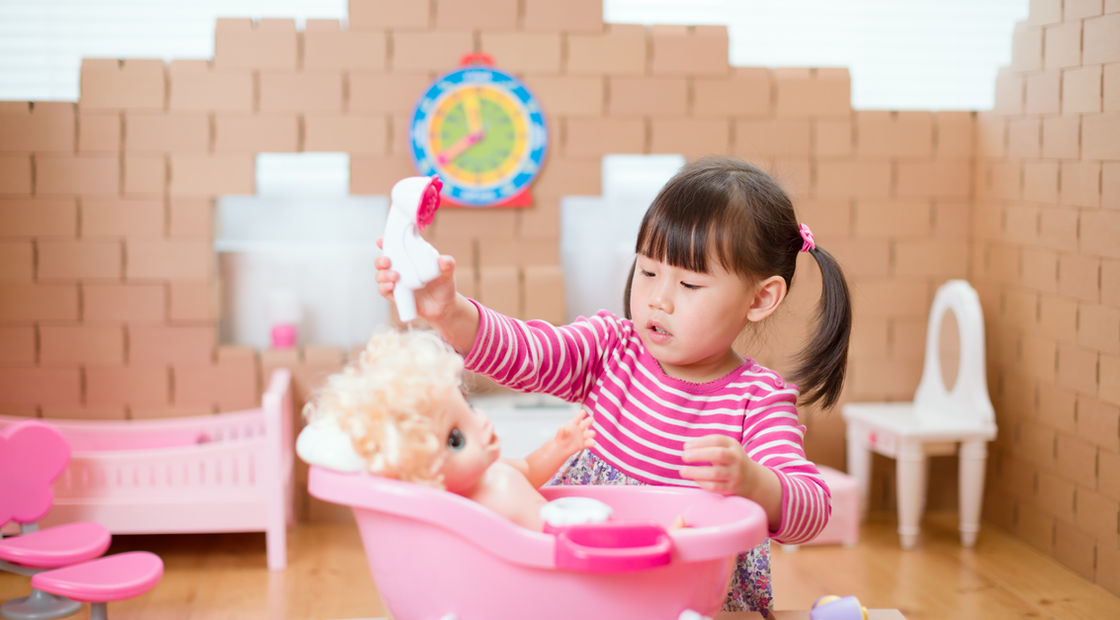
- Pretend play emerging — pouring tea, feeding a doll, "talking" on a toy phone, copying you
- Language bursting — short sentences and lots of "I want that," "No," and "Mine"
- Big emotions when things don't go their way
- Sleep and mealtimes becoming a battle of wills
None of that, on its own, is a red flag. It's the soundtrack of a two-year-old discovering they're their own person.
What do speech therapists look for at age 2?
Our speech therapists use these as broad checkpoints — a guide, not a stopwatch. By around age 2, most children are:
- Using at least 50 words and starting to combine two words ("more milk," "daddy go")
- Asking for things with words rather than only pointing or pulling
- Following simple two-step instructions ("get your shoes and come here")
- Starting to refer to themselves by name
- Understood by familiar adults at least half the time
- Beginning to ask simple questions ("what's that?", "where go?")
What do occupational therapists look for at age 2?
Speech is only part of the picture. Our occupational therapists look at:
- Sensory responses: Does your child consistently refuse to touch textures like sand, grass or food? Meltdown at everyday sounds? Crave intense crashing and spinning and struggle to stop? Or seem unaware of pain or temperature? Some sensitivity is completely normal — what we look at is the intensity, and how much it disrupts daily life.
- Fine motor skills: Scribbling with a crayon, stacking four to six blocks, turning the pages of a book.
- Self-care: Starting to use a spoon, attempting to remove clothing, drinking from an open cup.
- Play skills: Pretend play emerging — feeding a doll, "cooking," copying daily life.
- Attention and regulation: Staying focused on a play activity for a few minutes at a time.
If several of these look hard for your child, it doesn't mean something is wrong — it means a conversation could be useful. (Not sure whether speech or OT is the right starting point? Our guides to late talkers and occupational therapy for children go deeper on each.)
What can I try at home right now?
Small, everyday moments add up — and at this age, you are your child's most powerful "therapist." Match the strategy to what you're noticing:
- Using 50 words: Narrate everything you do together - out loud, all day
- Combining words: Expand what they say: "More" → "More juice!"
- Pointing to pictures: Read together daily and name everything you see
- Following instructions: Sing simple action songs ("heads, shoulders, knees and toes")
- Comfortable with messy play: Start with dry textures — rice, sand, beans
- Managing crayons: Try chunky crayons and finger painting
- Accepting food textures: Offer new textures alongside familiar favourites
- Holding attention: Keep play short and structured — about 5 minutes, then switch
What actually helps a 2-year-old's communication?
Beyond specific activities, a few principles make everyday interactions far more powerful:
- Let them try first: Resist jumping in — the struggle is the learning. "I do it!" is a milestone to celebrate, not a battle to win.
- Model the words you want, playfully: When they reach for something, give them the script: "Help me!" When you hand them a snack: "For you!" When they pass you something: "Thank you!" They're listening even when it doesn't look like it.
- Reward the attempt, not the perfect request: When your child tries to communicate — a point, a sound, an almost-word — respond within about three seconds and give them what they're asking for. Making requesting feel easy and fun is how language grows. Don't make it a test; make it a game.
- Praise the trying, not the result: "You worked so hard putting those shoes on!" builds far more resilience than getting it right first time.
- Sing — and pause: When you reach the last word of a familiar song, wait a few seconds. That little moment of playful anticipation invites your child to fill in the blank — one of the most powerful language-building strategies there is, and it feels like play.
When is it worth checking in with a professional?
Most 2-year-olds are doing exactly what they're supposed to — asserting themselves into the world. But it's worth reaching out if:
- Your child has fewer than 50 words, or isn't combining two words ("more juice," "daddy go")
- Pretend play is absent — they're not imitating daily life like feeding a toy or pretending to cook
- Meltdowns are very frequent, very long, or very hard to recover from
- Your child strongly prefers being alone over playing near others
- You're finding daily life very hard to manage and would benefit from some guidance
That last point matters: you don't need a "serious enough" reason. Support for you is a valid reason too.
Why is it worth checking in early?
Waiting has a cost that's easy to miss. When children feel a gap between what they want to do and what they can do, frustration builds — and when they can't use words, their behaviour starts doing the talking. Starting preschool can make difficulties more visible, because group settings ask more of a child than home does.
The encouraging part: at 2, the brain is at its most plastic, so children respond fast. Early support usually means fewer sessions, not more — there's far less to untangle later. And the goal isn't dependency; it's the opposite. With a solid home programme, you become your child's best therapist, and once the strategies click, most children simply take off.
In other words: early support isn't a long road — it's a short bridge to a strong start. You're not labelling your child. You're giving them a head start.
Frequently Asked Questions
Is my 2-year-old a late talker or is something wrong?
Some 2-year-olds are late talkers who catch up, and some benefit from support — and there's no reliable way to tell purely by waiting. By age 2, most children have around 50 words and are starting to combine two. If your child isn't, a speech and language assessment is worthwhile, even if only for reassurance.
My toddler understands everything but barely talks. Should I worry?
Strong understanding is a good sign, and some of these children are late bloomers. But "understands well, doesn't talk" is still worth an assessment by age 2 — it's the most reliable way to know whether to wait or to act.
Does checking in mean my child will need years of therapy?
Usually not. At this age children learn quickly, and many families simply need the right strategies to use at home. Early support is typically shorter, not longer, than support that starts later.
Could my 2-year-old's tantrums be linked to speech?
Often, yes. A toddler who can't make themselves understood gets frustrated easily, and supporting communication can noticeably reduce meltdowns. Our terrible twos guide covers the tantrum side in detail.
Does bilingualism explain my child's delay?
Bilingual children are not delayed in the long run, and bilingualism carries cognitive benefits. Count your child's vocabulary across all their languages. If a delay persists across every language they hear, it's worth an assessment regardless of bilingualism.
Do I need a referral to see a speech therapist or OT in Singapore?
Not for a private therapist — you can book directly. Public pathways usually involve a paediatric referral.
Wondering whether your 2-year-old could benefit from a little support?
The Little Marvels team helps families across Singapore figure out exactly that — sometimes with reassurance, sometimes with a short, practical home programme.
References and further reading
- Brazelton Touchpoints Center, Boston Children's Hospital: brazeltontouchpoints.org
- KK Women's and Children's Hospital — child development milestones: healthxchange.sg
- Singapore Medical Journal — "Speech and language delay in children: a practical guide" (2023): journals.lww.com/smj
- HealthHub (Health Promotion Board, Singapore): healthhub.sg
This article is for general information and is not a substitute for professional assessment. Every child develops differently.
More for parents
Browse more helpful articles, or reach out any time to talk to our team.